Showing posts with label Tottenham. Show all posts

Tuesday, 11 November 2014

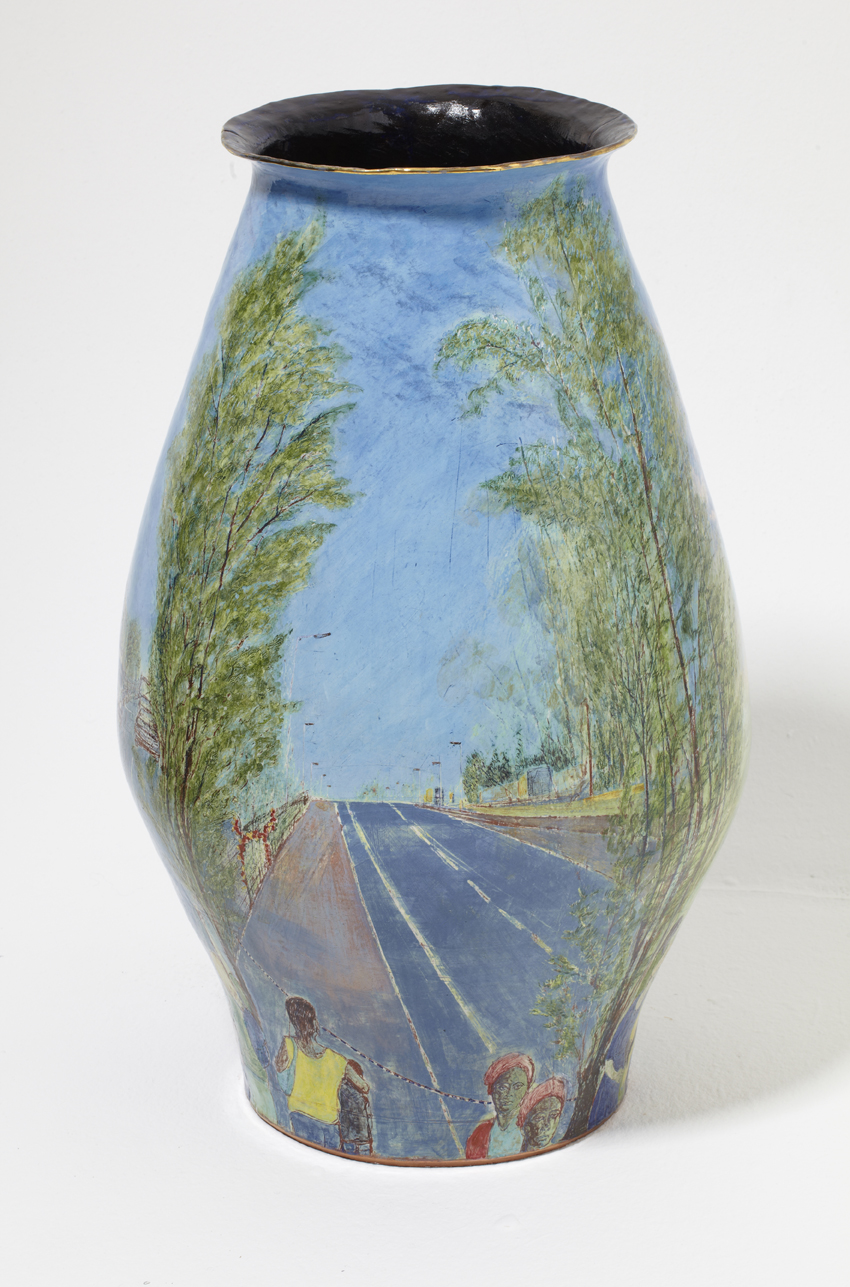
St. Mark of the Farm, 2012

St. Mark of the Farm, 2012 (four views plus one showing scale at the end.) 
appprox 82cms high x 45 wide

Contact me at thelab@claudiaclare.co.uk for price list and to see the pot.

You can read more about this pot here.


Wednesday, 15 August 2012

A Wedding and a Funeral: two pots in my forthcoming show at Francis Kyle Gallery

-->


Images from top:
1. St. Mark of the Farm (left) and Wedding Procession (right)
2. St. Mark of the Farm
3. St. Mark of the Farm 
4. Wedding Procession
5. Wedding Procession
6. Wedding Procession, (detail)

Introduction

Two pots, both based on classical storage jar shapes and painted around the circumference as a frieze, depict verdant landscapes, dominated by tall trees against blue-grey, English skies. Both feature teams of white, plumed horses, swanky cars and quantities of bling. They appear similar at first glance but the events taking place within the landscapes could hardly be more different. ‘Wedding Procession,’ commemorates the marriage of Prince William to Catherine Middleton in April 2011. The event and the way it was mediated affirmed the continuity of monarchy and the power of the state. ‘St. Mark of the Farm,’ is a record of the funeral of Mark Duggan, who was shot by police on August 4th 2011, precipitating four nights of rioting. Duggan’s story is still extensively mythologised. He is, at once, the Hero: ‘people looked up to him;’ Villain: ‘Starrish Mark, leader of the notorious Star gang;’ Saint: ‘he was a lovely guy, everyone knew him, he wouldn’t hurt a fly;’ and Martyr: ‘a fallen soldier.’ His funeral, all in white, with white lilies on the casket like the virgin bride, was in September, six months after the wedding. The similarities in appearance were beguiling but they served only to emphasise the vast social difference. It was a spectacle of inequality, a mis-matched pair that bookended the summer and seemed to define the troubled social politics of the time.

Wedding Procession

The Royal Wedding was a brilliantly choreographed spectacle and a thoroughly crafted conceit, where sharp contrasts and rigorously controlled separation together defined the illusion of a shared national drama.

The pot form provides a stage where the separation and contrasts become visible. We cannot see the bride in her carriage because she is obscured by trees. At the event itself, the public were separated from royalty by both the physical barriers and the carefully mediated story, a richly embroidered fairy tale. The public are ‘below stairs’ on the pot - below the outermost curve. The separation is emphasised by the receding perspectives above and below the curve. The wedding procession itself takes place on the upper section among the trees, reaching up towards the skies.

This was the first of the English royal weddings to encounter and be captured by popular mass communication. The public are depicted photographing the event, a forest of outstretched arms pointing their camera phones towards the glimpses of procession visible through the trees. Of the images uploaded to the internet, the most photographed part of the wedding was the runaway horse whose journey was captured at every stage. The official ‘central’ figures were marginal by comparison.

To make the pot, I looked at an endless stream of flickering, moving, transitory and, often, ephemeral images and painted and fired a selection of them into a material that lasts for thousands of years – icing on the fictional cake perhaps.

St. Mark of the Farm

Set in and around Tottenham and the Broadwater Farm estate, St. Mark of the Farm shares many visual and narrative elements with Wedding Procession. The trees, the procession and the white, plumed horses suggest a wedding, but this is a funeral. It is a deeply personal, family event where sorrow and loss mix with pageantry, spectacle and a suppressed public interest. Duggan’s story is also highly fictionalised, the romance of the ‘villain’ who dies a saint. The landscape, which embraces this drama is, par excellence, a romantic urban construction, simultaneously historic and contemporary. It is the landscape through which I walk daily to work, from my house in Tottenham, right by ‘the Farm,’ as the estate is known locally, to my studio in Wood Green.

Standing in Broadwater Farm, which wears its inner city notoriety like a badge of honour, is a confusing experience, particularly at dawn or dusk in winter when it feels mysteriously rural. At these times, this large estate often falls silent. The Moselle river, which was once reduced to a foul, concrete lined ditch in the 1960s, is now being retrieved with help from a lottery grant, and snakes along the bottom of the willow-tree lined valley with Alexandra Palace glittering in the distance. The last of the day light glows pink in the damp, starting-to-flood, valley floor and the moon appears above the roof tops to the south. At these times you can almost hear the cows mooing – it was a dairy farm until well into the mid-twentieth century and was then converted to allotments. Because of the flooding, there were no buildings until the estate was built in 1965 and the Moselle was forced, reluctantly, underground. Like all rivers it refuses to stay there and reappears every winter in the form of floods which, in turn fill with geese, gulls and migrating birds, adding the extraordinary rural illusion. Mark Duggan grew up on this estate. His family are still there.

The pot uses all the elements of the landscape and exaggerates and idealises them to enhance the narrative. The idealised Mark, the saint, the ‘family man,’ is suggested by the evening landscape with the river, which is borrowed from the background landscapes of pre-renaissance, religious paintings. The three distinct scenes are those of the birth and early life, the death, and the funeral. The death landscape is Tottenham Hale, a low horizon line, bleak, empty and soulless, a reality of the place itself and an inescapable metaphor. The Farm is, co-incidentally, the lowest point in the landscape for some miles around, so the only way out of the estate is up hill.  The blocks of flats were built on giant concrete stilts, with aerial walkways instead of streets because of the flooding and these too have become part of its notoriety and mythology. The cemetery at Wood Green, where Duggan is buried, is, by contrast, on the brow of a hill, commanding a fine view across north London. It is here, at the funeral in white, that Duggan completes his transformation from villain to hero to martyr and finally to saint.

The Role of Landscape

I made the pots to remember and to witness the events they depict. I chose to emphasise the image of the landscape in which they occurred as a metaphor for the construction of social myths. What constitutes an urban or rural landscape cannot be taken for granted. Urban landscapes can be much more verdant than their rural counterparts and are often, wealthier, less industrialised and more nurtured. The rural ‘idyll’ is more apparent in the wealthier parts of London, with its carefully selected native English trees and artfully tended ‘wild’ areas, than in small-town England, where industrial farming is in a state of decline and rural poverty results in neglect. The Royal Wedding took place in central London, the centre of power and wealth and the seat of government and monarchy. In this setting, it also resembled a magnificent mythic hunting scene from a Renaissance tapestry – a resemblance I sought to repeat on the pot by introducing exotic birds in the trees and flattening the perspective.

Mark Duggan’s funeral took place in one of the poorest parts of London. One might have expected a landscape of bleak estates, broken windows and impressive graffiti. But this kind of grit-chic is another romantic urban construction, generated in the studio for music videos. There is certainly nothing like it in Tottenham in late summer. On the contrary, the traces of its rural and prosperous past are splendidly visible at this time, in both parks and streets, where the vast mature Willows, Oaks and Ash dominate the landscape. Wood Green also carries the memory of a prosperous suburban history. ‘Arcadia Gardens’ is not a fiction – or not on the pot anyway. That really is the name of the road.

Landscape does, however, become a part of the political analysis of spectacular inequality if we compare the image of the Royal couple in the Aston Martin in the Mall with the remarkably similar image of Tottenham Hale, where Duggan was shot. The low horizon lines are similar and both images are framed with abundantly leafy trees. While the Aston Martin and balloons are the decorative feature of the royal landscape, the road at Tottenham Hale appears to go nowhere and the only decoration is the cascade of synthetic flowers adorning the railings, a shrine to the ‘fallen soldier,’ or rehabilitated ‘saint.’

Sunday, 19 September 2010

In Your Name: The Inconvenient Politics Of Palestinian Handicrafts


On the face of it, the ‘Justice for Palestine’ flag laid out on a stall selling plants and handicrafts seemed out of place at the fourth annual Tottenham Flower and Produce Show, an urban ‘village’ show with big white tents, vegetable competitions for allotment holders, a home crafts section, a dog show and various ‘side shows.’ The plants were local but the handicrafts on this stall were made by Palestinian women from a town called Azaria, divided in two by the accursed Israeli wall. Embroidered, stitched and crocheted objects jostled for position with olive oil, fragrant seeds and herbs and hand made soap. They were being sold by Haringey Justice for Palestinians, (HJP), a small local charity which does income generating projects with the people of Azaria which is now twinned with Haringey. The purpose of the stall was both to raise consciousness and therefore more support in the area and also to raise money - desperately needed income for families living ‘behind the wall,’ cut off from their work and even from family members, under siege in effect, by the Israeli occupation.

So, what was it about this stall that was still producing a sense of doubt and discomfort chewing at the edges of the otherwise pleasant experience of looking at the pretty, embroidered objects set out before me? 


In the current political context, groups supporting the Palestinians, including this one, must deal with an additional, increasingly difficult and demanding problem. Put very simply, much of the Palestinian struggle is ‘supported’ by Lebanese Hezbollah, and by Hamas, both of whom are in hock to the current Iranian ruling regime. Like it or not, all of these  campaigns supporting the Palestinians, including eminently sensible, practical ones like HJP, have the territorial scent markings of Iran sprayed all over them. They are inextricably linked. The violent oppression of dissidents in Iran, the mass rapes of Iranian women and men in prisons, the torture, the executions and the shootings and beatings on the streets, are all done, in the name of the Islam and, in particular, in the name of the Qods and of Palestine. The Palestinian women stitching those small bags and crocheting the flowers didn’t ask for Iran's support and certainly not for their slaughter, but they’ve got it and now their supporters must deal with it.


The problem for the Palestinians is twofold. The first and, for them, the most urgent, is that the Iranian regime needs dead Palestinians, as many as possible, especially women and children, to prop up its ailing government. The only support it has left in Iran is the hard core of Iranian Hezbollah who will continue to support them as long as Palestinians are dying at the hands of Israeli soldiers. Hence the necessity to ensure that they do go on dying. Bluntly, a dead Palestinian is worth far more to the Iranian regime than a living one. A prosperous, cheerful, independent Palestinian is no help at all and a prosperous, independent Palestine would spell the end of the Islamic Republic in Iran.

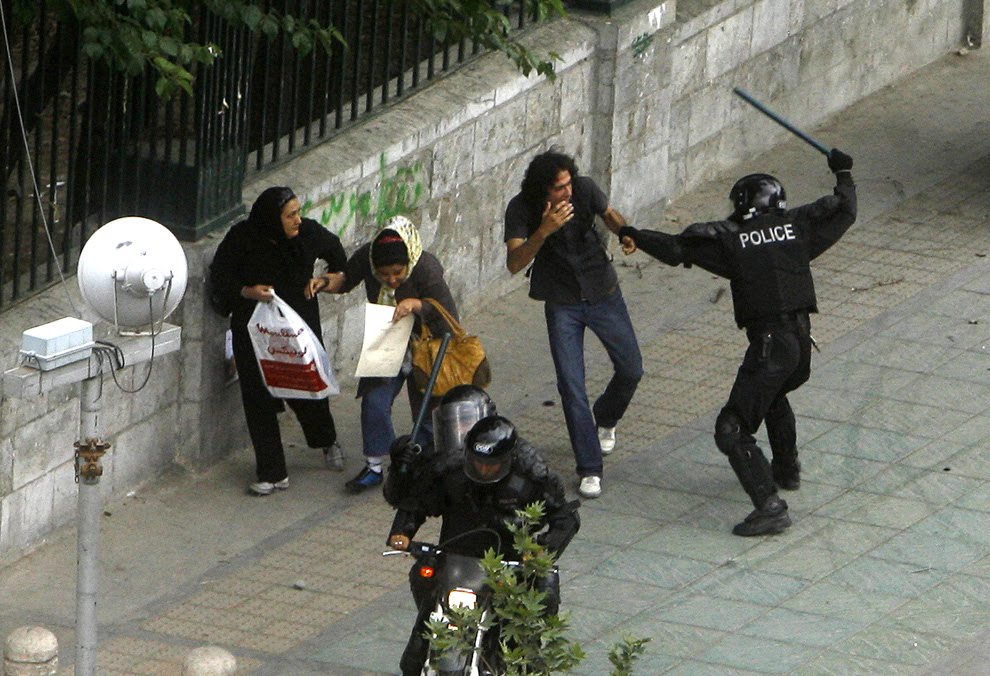
Tehran 2009: Police attacking protesters after the 2009 election

The second problem is that much of the support structure, in Britain and elsewhere in the West, is cheerfully burying its collective head in the sand and ignoring what Iran is actually doing in Palestine and, even more, what the same regime is doing in Iran itself – namely murdering Iranians at a rate and with a degree of impunity which would make any Israeli government green with envy.

HJP is affiliated to Palestine Solidarity Campaign, both of which have laudable aims. While both organisations carefully state their affiliations, their links, their patrons and their sources of support and what they aim for and what they do not support, (the latter includes ‘all forms of racism, anti-Semitism, and Islamophobia’), there is a howling silence on Iran.


Iranian Street Protester: Tehran 2009

They must now declare their independence and condemn, unequivocally, the atrocities meted out to Iranian dissidents by the ruling regime. This must be clearly stated on their websites and, wherever possible, on their publicity material. They can no longer ignore what is happening in Iran. No longer can they state that it may not really be so, that it is just an invention of the Western press, (or ‘Zionist’ as some prefer), they cannot afford to risk colluding with a hard-core proto-fascist regime which celebrates the deaths of Palestinians as much as it celebrates the rape and death of its own dissidents.


Tehran 2009: Police attacking protesters

It is time for all of these groups to adopt another ‘not in my name’ badge, a second one. This one might have an electric baton, an image of the Iranian basiji beating the life out of one of the women protesters or a crane with a dead Iranian protester hanging by the neck. They need to do this as a matter of urgency, because it is being done in their name.

The thought and care put into projects such as those of HJP is fatally undermined by this cavernous silence. Maintaining silence, in effect sacrificing one set of lives, (Iranian lives) in order protect Palestinian lives is manifestly absurd. And who wants to buy a lovingly embroidered oyster card-holder drenched in the blood of Iranian street protesters?

Saturday, 6 June 2009

Job Centre Honey-Plus

OUT OF ORDER announced the job-hunting machine, folding its arms and refusing to budge. OUT OF ORDER added the photocopier, idly staring out of the window. Wood Green Job Centre Plus commands a magnificent view across one of Haringey’s many fine public gardens. This garden boasts a 25 metre pergola draped in abundant pink roses and twirling with Wysteria, glistening lawns and perfectly cropped hedges. The centre was milling with the recently unemployed - all trying their best to look positive - in sharp contrast to the uncooperative equipment that had decided to take Friday off.

I eventually found reception and was told go upstairs to another reception where a nice lady told me I’d come to the wrong place entirely – I should have been at White Heart Lane apparently – but she’d try and persuade ‘an advisor’ to see me. ‘Hmm,’ she muttered, ‘you’re the second doctor I’ve seen this week.’

I waited and filled out a form and waited some more and looked out of the window and did some reading and had a stretch and then another nice lady passed by and offered me strawberries which I refused but felt inspired to do a few shimmies instead. Various rather smart people were congregating on the sofas by now, all eagerly filling out forms and waiting and chatting bravely to each other like one of those mad self-improvement seminars convened by some organisation desperately trying to justify its funding. I was then assigned an advisor.

The divinely pretty woman with glistening white teeth looked out from under her dark fringe, smiled beatifically, puckered her darling, perfectly sculpted, little eyebrows and cooed, very softly, ‘what are you dooo-ing here???’

I warbled on about this and that and being in the studio and so on and so forth and she glazed over with the sheer tedium of it all and then asked if I liked going to ‘foreign places.’ Yes I said, about to launch into a blow by blow account of my adventures in and not in Iran but, before I’d completed the first sentence, she smiled again, ‘that’s good. You could go somewhere else and do your arty-farty stuff.’

Time passed pleasantly enough, we signed this and that and I wrote down a few things and our lady of the strawberries passed by again, this time followed by an angel of biscuits, and then my own advisor-princess, by way of closure, gazes at me closely, then, tilting her head to one side - oh so prettily - and smiling even more, she asks: ‘why are you single?’

Wood Green marriage bureau can be found at 1 Western Rd, London, N22. It has curved walls like a ship and beautiful views. I doubt that Tottenham High Rd, where I now have to sign-on, can compete – but who knows?

Thursday, 21 May 2009

Back To The Shop: More Adventures In Philip Lane

Things are hotting up considerably at the corner shop these days. The marching songs still embellish the police sirens in Philip Lane and the price-war continues, happily for the customers. I’ve more or less abandoned Yasir Halim now, in favour of Euro Stores and Mr. Ocean. I interrupted a tumultuous row the other day, arguments being bellowed from one side of the Ocean to the other, ricocheting off the fennel and back to the beer, then up an aisle to the carefully arranged sheep heads and back to the pasta and round again, taking in the grape-seed molasses on the way. Bewildered, I announced that I agreed with HIM and waved towards the tallest, in gold chain, who grinned from ear to ear. Ah-ha, muttered the lad at the counter, checking the change, so you ARE a communist.

They’d been arguing in Kurdish so I hadn’t understood a word. I clearly wasn’t going to be served unless I demanded attention and that seemed the best way to do it. Gold Chain was clearly delighted at my declaration of partisanship. ‘We just need to bring back communism and everything will be ok,’ he announced, beaming beatifically. I wondered when it was that Philip Lane, or Tottenham, or perhaps it was the whole of Haringey, had been a communist enclave. Had I missed something? Counter lad explained that Gold Chain was ‘going back to the mountains to fight.’ He seemed confident that I was now a fully paid up, card carrying member of Gold Chain Communists Inc and that I would repair at once to my cave and make ready to join the march.

I can barely carry a Kalshnikov, let alone fire one, but I will admit to having once had a go. I shot a collection of beer bottles in the mountains outside Dogubayzit, on the Turkish Iranian border. Mr. Siam Shahin, who runs Murat Camping, a tourist camp-site close to Ishakpasha Palace, had taken me there to show me his eleven, glistening smuggling horses. He was a kind of Kurdish God-Father figure, who smuggled alcohol into Iran on horseback, and brought back electrical goods and people- at vast cost presumably. He told me he ran schools for Kurdish children in the mountains. He’d been proudly displaying his gun collection to me and others staying at the camp-site. I admired the Kalashnikov and foolishly remarked that I’d always wanted to fire one. ‘I’ll teach you,’ he offers. You don’t refuse a man with four guns, so I went into the mountains for my first, (and last), fire-arms lesson. It weighed about 25 kilos and jolted back into my shoulder every time I fired it. I did hit a couple of bottles, but not the ones I was intending to hit. Satisfied I’d be a hopeless freedom fighter of the armed variety, I retired to nurse my bruised shoulder.

I just want to make it absolutely clear this was not a ‘training camp’ of any sort. Shehir enjoys very cordial relations indeed with the Iranian Consulate in Erzerum and I had gone there to see if he could extract a visa for me. To say that he was, and presumably still is, an extremely unsavoury character would be an understatement - the more so, somehow, for being so thoroughly personable. It took me about four days fully to realise and then accept exactly how unsavoury he was. The Kalashnikov story sounds like one those cheerful little travellers tales. On the face of it is, but it involves some of most toxic characters I’ve ever met in my life. The people he was bringing over the border, I subsequently found out, were women that he sold to the hotels in the area to provide sex to Russian traders. I hope Gold Chain’s just shooting his mouth off. If not he’ll find himself involved in one the main trades that funds the PKK. I’d rather he just tried to ‘bring back’ his communist enclave in Philip Lane any day.

Monday, 26 January 2009

Philip Lane: A Tale of Treachery, Protection, Cucumbers and Marching Songs.

Cemal calls round last week. I haven’t seen him for ages. He’s been keeping a low profile in a charming northern city somewhere, railing against the lack of proper Turkish supermarkets, giving up smoking, complaining, nay mewling, about those other Kurds, those ‘Iranian’ ones, who turned out to be Iraqi, but also enjoying a good moan, breathing cleaner air, and getting very attached to his local, premier league, football team.

So we stroll out in the morning frost to investigate Philip Lane which, I realise, has completely changed since his departure last year. Now, he used to work at Aksu, little Aksu, the veg shop on the corner of Kitchener rd, that’s where I met him. Then the bigger shop by the bus stop, big Aksu, committed an act of unspeakable treachery. It started to stock vegetables too, not as well kept as those on the Kitchener rd corner, but veg nonetheless. The upshot was that little Aksu went 24 hours, then closed and was sold, unable to compete with its treacherous neighbour which now sold alcohol and veg. Little Aksu didn’t have room for alcohol and anyway Hussein’s wife was observant and didn’t really approve, so Hussein went and got drunk at the Turkish tea shop at the back of Botany Bay pub opposite and gambled away the shop’s meagre profit.

So, the ever stoical Cemal migrated over the road to work at Ocean Stores, another Turkish supermarket. We had only two so naturally a third was necessary. Mr. Ocean must have been a bit loaded so he bought up little Aksu as well and turned it into a butcher. That lasted less that a year, and was bought by Mr, Tea-shop-at-the-back-of-Botany-Bay-pub, affectionately known as ‘the Trafficker,’ on account of the alarmingly high turn over of Lithuanian women who worked at the bar in the tea-shop. So the Trafficker buys out the butcher’s shop and turns it into – yes that’s right – another of his lovely tea shops, because we’ve got only fifteen of them in Philip Lane / West Green road so, clearly, we need another.

Well then Mr. Ocean buys up the Turkish hostel at the back of Ocean Stores where my friends Cafar, Bilgen and their children used to live (in one room with the children in a bunk bed under the stairs in a corridor - happily they now live in a nice big flat at the back of Tescos opposite Seven Sisters), and where Cemal used to live, ‘bunking up’ with his mate, Rifat, and he, Mr. Ocean, extends Ocean Stores to include the butcher again. It’s now a pretty substantial supermarket. He even thoughtfully drops the price of soya milk from £1.29 to £1.19, having noticed at long last the Big Aksu has been selling theirs for £1.19 ever since they committed the cucumber coup.

Then what? Well, Botany Bay Pub was closed down and sold off around Christmas last year. Lately there’s been much activity and buying in of shop fittings and I ask the nice young woman at Ocean Stores what’s happening. Ocean Stores by now has doubled up as the local recruiting agency for the PKK. If you go there at the right time of day, there’s now a very chatty lad who plays, ‘communist marching song’s’ according to him. ‘I’m not supposed to,’ he confides and then starts trying to interest the hairy English anarchist man behind me, sporting ginger beard and desert fatigues, in joining up. He looks at me and boldly asserts, ‘there are almost as many women in the PKK as there are men, you know.’

I’m interested in more mundane matters though and, as the nice young woman counts my change, she informs me that Botany Bay is to be another supermarket – a really big one. ‘What sort of supermarket, which supermarket?’ I demand, dreading the onset of Tescos or similar. ‘Another Turkish family,’ she growls, and flares her nostrils for added emphasis.

Thing is, I cant see either Big Aksu or Mr Ocean going down without a fight and, given Ocean’s affiliations and Aksu’s protection racket which, according to Cemal, he started around the time of cucumber coup, I’m not sure if the sheer size of Botany Bay will be enough. The C Word’s prediction for 2009 is local skirmishes breaking out on the borders of N17 and N15, (BB is N15, Aksu and Ocean N17 – Philip Lane is the border,) resulting in possible all out war later in the year.

Maureen at the Laundrette on the corner of Philip Lane and Clonmell rd offers the best vantage point for anyone interested in observing from her splendid, full-size, picture windows. It was ideal for observing the fights at the pub and I’ve no doubt she’ll offer front row seats, tea so strong you could tar the road wit it, and a plentiful supply of her own unique Irish wisdom for all patrons in need. She also does a very fine line in second hand books. I wonder if there’s one about the battles of Broadwater Farm. Ah, now there’s another story. Thelma at the flower shop over the road can tell you all about that.

Monday, 15 September 2008

Tottenham Flower Show, 2008


After all my proclaiming that a Tottenham Flower and Produce Show would be a very fine thing, if only someone would organise it, I find I’m behind the times. Someone has organised it. It started last year. Imagine my excitement. No more that 30 metres from my very own front door, September 13th, 2008, was the very flower show I yearned for, complete with tents, band, (wonderful Irish dance music), and tea tent.
The exhibition tent was THE BUSINESS. Packed to the eaves with enthusiastic citizens anxiously awaiting the announcement of the first prizes, the trestle tables fairly groaned under the weight of sponge cakes, loaves of bread, fruit pies, chutneys, jams, honey, knitted and crocheted items of many kinds, quilts, bunches of herbs. Eat yer hearts out sour-faced estate agents, police, taxi drivers and all you other miserable sods who always run Tottenham down at any opportunity! Come and see what we can make! There were donkey rides, a dog show and the paddling pool was clean and glistening for Tottenham’s youngsters. The tea tent was a bit small and understaffed, but the teas and cakes were the best I’ve had in years. Sorry Wootton, you were outclassed I’m afraid. We even had a broderie-anglaise table cloth for the communal trestle table. So there!

Urban or Rural?
If Wootton is really a suburb, what does this make Tottenham? Is it an urban village, is it also a suburb? I don’t think either description fits. To me, Tottenham feels like a small town which has somehow got itself muddled up with London. The show is in its infancy and has a few ‘teething problems’ – such as the too small tea tent - where are the WI when you need them? I have high hopes however. I suspect it will be a much bigger do twenty years from now. I’d like to see much more participation from some of Tottenham’s newer populations, such as the Kurdish ladies I’ve mentioned elsewhere on this blog, who do the magnificent sewing. There is something about this kind of occasion that provides exactly the right context for craft, in the sense that it becomes ‘home craft’ again and, in an instant, all that craft agonising is removed.
So, in keeping with that spirit, the C Word is awarding ‘best in show’ again and, on this occasion, it goes to the woman who made the knitted shopping bag out of those beastly blue carrier bags that every corner shop uses – she’d knitted the bags together. BRILLIANT!!! I loved it. Pictures above. So that’s it for this summer. The C Word is back from holiday and open for business from now on.
See you very soon with a short comparative review of two shows which opened on September 11th, Richard Slee at Barratt Marsden, and Elspeth Owen at the Hart Gallery.

Friday, 5 September 2008

Cabbages and Quilts: The Wootton Flower and Produce Show, 2008.


Cabbages and Quilts: The Wootton Flower and Produce Show, 2008.

Ra tatataaaaaa, drum rolllllll, ratatat, dum diddle dum diddle dum dum dum. Intermittent strains of brass band music twirl around tents and idling teenagers, village elders and passing visitors, all of whom milled about the glistening green lawns and drifted in and out of immaculate white tents at this year’s village flower show. If ever there was an act of faith, a testament to optimism it was this. A rain drenched, wind swept, dripping cold August had put aside one fine day, Saturday 30th, for Wootton’s annual extravaganza of cabbages and cakes. Apples and preserves, cable knitted cardies, quilts and roses, all expertly assembled, jostled for position on their tables, and were justly, or unjustly, rewarded. An incident over the gladioli was duly calmed, the wasps sought refuge in the prize-winning cake, and everyone delighted in the glorious sunshine which bathed the tents and lawns and gardens all day.

So here it is, an authentic village flower show, which, as far as I can see, is still pretty much as it was 40 years ago, when I won first prize for a painting, aged 6. No one’s gone out of their way to insist in its unchanging state. It just hasn’t changed. Of course the people have. I’ve drifted off to London and the village has been almost entirely repopulated but the flower show still has runners and beets and marrows and carrots and ‘garden on a plate’. My niece made a mangrove swamp one year. She’s still feeling misunderstood because she didn’t win a prize. She’s 21 now. The ‘home craft’ is still astounding. It doesn’t seem even slightly naff to me, not in this context. It’s quite at home here. The exquisite smocking is for someone’s new baby, the tea cosies are for teapots, the quilts for someone’s bed, the knitted cardies will be worn, the wooden toys played with. I know, it all sounds too idyllic, but it is true. I don’t quite know how it is that people have the time, but the work is here to prove it. They’re not trying to make a living from it, which helps, but it’s all made for a purpose.

This should not be mistaken for ‘rural’ craft. Certainly Wootton is a village and is in ‘the country’. It is, however, a suburb in character, but one that is detached. It is one of the wealthiest areas in England now and its economy is entirely urban. No one goes to work in the village. Everyone who lives there works in neighbouring cities. The place is deserted during the day, apart from the school – ah ha, so there are teachers who work in Wootton, and as very small number of people who come to clean houses and maintain gardens. So Wootton flower and produce show is a product of urban – not always wealth, but stable income - combined with a mixture of creative domestic activity, good gardeners, - and these are the ones cared for by the owners, not paid gardeners, - and an industrious spirit – oh and a touch of neighbourly competitiveness. Tottenham flower and prod show would be very similar. There are enough people with a stable income to fund the creative domestic activity, a wealth of domestic skill, and we even have the ‘country’ house, - Bruce Castle – which can compete with any in the land – and we have the 400 year old oak trees. It would just be a more multi-cultural that’s all.

As to craft, village craft vs. gallery craft, well – craft it seems becomes a problem requiring scrutiny, only when it departs from the flower show and from that use/comfort/decoration mix to something that either questions itself and what it’s doing in an industrialised society or when it is used as a medium to explore ideas which are part of its habitus, probably, but not part of it usual or original social role.

This seems like a good place to leave this post which serves, I think, as a good introduction to the next series of posts which will talk about Ceramics in the City, Origin and so forth, as well as a fond farewell to the summer holiday – such as it was.

Monday, 7 July 2008

The C Word's Flowershow, Messy Tuesdays, Home Craft vs Gallery Craft and Taking a Break


The C Word is just going to take a short break from posh gallery craft to get back to a bit of the other sort of craft, home craft, which in my view, is the basis for all of this anyway. This is the C Word’s very own flower show. I have great ambitions about organising, or finding someone else to organise, Tottenham flower and produce show, but for now, it will have to be a private affair.
So welcome to the garden as it was about 3 weeks ago. This was one of its most abundantly flowery, sun-filled moments. Then it went dry and overgrown, and now, hurray for rain, its being replenished I hope.
We should really have a discussion here about ‘gallery craft’, ‘home craft’, ‘fine craft’ and maybe even craft blogs, but I’m going to pass these matters over to others for now. Take a look at an excellent craft blog called Messy Tuesdays, which has links to its host blog, I think it is, called Knitwit, which has numerous links to other knitting and sewing blogs, and the venerable F Word, here discussing the Messy Tuesdays concept. In honour of the MTs, I wanted to include the less than perfect pictures, but then I wanted you to see my roses at their best. So, the gaudy front garden picture is the messiest its going to get for this post, unless I tell you about the truly disgusting antics of my resident black birds when they eat slugs, (yes, I’m delighted about that bit), but then they smear the slug slime of which there is a surfeit, all over the path outside my back door. Then it rains, and reconstitutes itself as a soup of slug slime, then I go out in my bare feet to empty the tea pot over my strawberry bed and tread in the said slime and then it takes about 20 minutes of soap and scrubbing to find the soles my feet again, under a thick layer of slime. Surely there is some good use for this loathsome stuff – anyone?
The great thing about MTs and all those related interlinked blogs is that they talk craft in the domestic context, the home-made; that fine line between domestic comfort (or not) and oppressive ideal-home aspirations, in the presence of the empty tea-cups and the unwashed saucepans. I also want to talk village flower show craft, the village hall vs the art gallery. My village, Wootton by Woodstock, will host its annual flower and produce show at the end of august, so prepare to meet tea cosies to die for and a patchwork quilted allotment, as long as I can find the woman who makes these things and persuade her to let me photograph them. Meanwhile, enjoy the roses, and send in your slug slime recipes, but not too many, please.