I'm Not The Criminal
The dominant image of, 'I'm Not The Criminal,' is the portrait of Fiona Broadfoot, a sex trade survivor and campaigner for the abolition of the sex trade. She is one of three women who, with the Centre for Women's Justice, brought the judicial review to have the criminal convictions of exited women removed from the records. Currently, those convictions remain on police records for one hundred years - longer than the life of the woman herself - surely one of the most inhumane and vindictive legal sanctions we have in Britain and wholly unjustifiable. The title of the pot comes from the hashtag adopted for the campaign, #I'mNoCriminal. I am indebted to Fiona for her help with this project, 'And The Door Opened,' which I'm doing in partnership with Women @the Well.


Two Titles
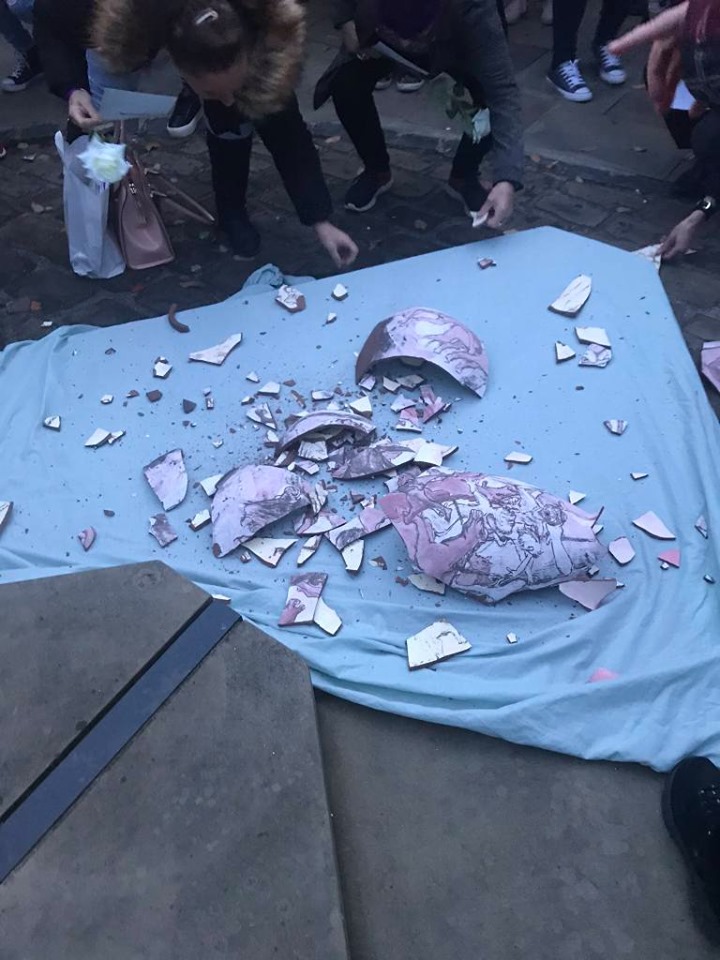
'I'm Not The Criminal,' in its unbroken state, was called, 'The Invisible Man.' On the outside, it depicts a burlesque of hideous characters on the sex trade merry-go-round. These are the men who buy sex, also known as punters/johns/tricks. You can call them what you want - they amount to the same thing: they are the men who pay to abuse exploited and prostituted women and girls. This is not an, 'equal financial transaction,' as some claim, they are buying the submission and, crucially, the silence of the women they abuse. It also depicts the pimps, brothel owners, hotel and escort agency owners, travel tour guides who run 'stag nights,' and so on. It depicts the men who 'groom,' in gangs, the church men, the legal teams who dismiss the testimony of the girls as 'unreliable,' and the police who arrest the exploited girls and women but not the pimps or punters. One of the reasons these pots are broken and rebuilt is to smash the power and dominance of the men and to bring out and emphasise the courage and persistence of the women to speak out, ‘break the silence,’ and campaign for change. This is also the reason for the changing title – it expresses the women’s refusal to submit to the social and legal sanctions imposed on them, and on all prostituted women and girls, and their capacity to wrest the power from the dominant abusive men to effect change in their own lives and in society.

Why ‘Invisible?’
'The Invisible Man,' was so called because the public conversation and focus of every second of media coverage from obscure internet channels to social media to mainstream TV and radio to print journalism, is on the women. It is hardly ever on the men. The men of the sex trade - who are its market, its life blood - the abusers and profiteers, define and embody the sex trade but they escape scrutiny and act with impunity day in day out while the women, the abused and exploited, get the blame and stigma. I am not wholly opposed to stigma - I just think it needs to be relocated - on to the men. I owe this title to Julie Bindel whose excellent book, 'The Pimping of Prostitution,' Palgrave Macmillan, 2017 includes a chapter on this subject, called 'The Invisible Man.' I would also like to alert the reader the work of Raquel Rosario Sanchez who is currently research men who buy sex using the reviews they write of the women they abuse in prostitution.

How and why: the images on the pot – inside and out
The pot is painted on the inside as well the outside. The inside is painted as the pot is being built up. The colours inside are lighter and brighter than the exterior colours so that once the pot has been broken and rebuilt the interior is clearly visible through the gaps. There are images of women on horseback painted inside. It is an allegorical and idealistic image of escape – as though the merry go round horses have come to life to carry the women away to a safer life. The portrait of Fiona Broadfoot was painted on the biggest shard, after the pot was broken. This was to ensure her image was complete. There are images of broken faces of women inside – again I have no wish to deny the damage the sex trade does to women and girls – but I do not want these to be the only images visible.
The merry-go-round motif on this pot is one I have used many times. It is perfect for the dynamic, turning form of a pot and allows a satirical, grotesque characterisation of the men depicted. The Merry-go-round horses get more vicious every time I paint them. These are biting and kicking the men, bucking them off and trampling on them. I want to express the violence of the sex trade - it is necessary to do so. I do not want to hide from it but I have no desire to reproduce images of sexualised violence against women by these men in pictorial form. Another reason to smash the pot is to expresses the violence.

Breaking pots
A fired pot can be pieced back together so that it, near enough, retrieves its original form. It is more fragile now and will break again if subject to further pressure but it is remarkably robust and will last well into the future. The method for making the pots is based on the expression, 'I was shattered. Now I'm piecing myself slowly back together.' Or 'I have to completely rebuild my life.' These and similar expressions are commonly used by anyone who has experienced major trauma. The process is a metaphor, in effect, for the trauma and the process of surviving and living into the future. Sex trade survivors often carry a deeply embodied trauma. They are vulnerable to further pressures but, nonetheless, many survive and, eventually, thrive.
Pots - photo credit: Sylvain Deleu.
Women @the Well, (W@W,) is a women-only service located in Kings Cross dedicated to supporting women whose lives are affected, or at risk of being affected, by prostitution. It also provides support to exit prostitution.
‘And The Door Opened,’ is a series of events with displays of Claudia’s pots, with talks and demonstrations that illustrate the lives of the women supported by W@W.
The aim is to enhance the public’s understanding of what prostitution is, to name the abuse and exploitation, and to show that, with the right support, girls and women do not need to live and die exploited in the sex trade – there are ways out.


Pots - photo credit: Sylvain Deleu.
Smashed pot - photo credit: Studio Twelve, Bradford
Women @the Well, (W@W,) is a women-only service located in Kings Cross dedicated to supporting women whose lives are affected, or at risk of being affected, by prostitution. It also provides support to exit prostitution.
‘And The Door Opened,’ is a series of events with displays of Claudia’s pots, with talks and demonstrations that illustrate the lives of the women supported by W@W.
The aim is to enhance the public’s understanding of what prostitution is, to name the abuse and exploitation, and to show that, with the right support, girls and women do not need to live and die exploited in the sex trade – there are ways out.