Things are hotting up considerably at the corner shop these days. The marching songs still embellish the police sirens in Philip Lane and the price-war continues, happily for the customers. I’ve more or less abandoned Yasir Halim now, in favour of Euro Stores and Mr. Ocean. I interrupted a tumultuous row the other day, arguments being bellowed from one side of the Ocean to the other, ricocheting off the fennel and back to the beer, then up an aisle to the carefully arranged sheep heads and back to the pasta and round again, taking in the grape-seed molasses on the way. Bewildered, I announced that I agreed with HIM and waved towards the tallest, in gold chain, who grinned from ear to ear. Ah-ha, muttered the lad at the counter, checking the change, so you ARE a communist.
They’d been arguing in Kurdish so I hadn’t understood a word. I clearly wasn’t going to be served unless I demanded attention and that seemed the best way to do it. Gold Chain was clearly delighted at my declaration of partisanship. ‘We just need to bring back communism and everything will be ok,’ he announced, beaming beatifically. I wondered when it was that Philip Lane, or Tottenham, or perhaps it was the whole of Haringey, had been a communist enclave. Had I missed something? Counter lad explained that Gold Chain was ‘going back to the mountains to fight.’ He seemed confident that I was now a fully paid up, card carrying member of Gold Chain Communists Inc and that I would repair at once to my cave and make ready to join the march.
I can barely carry a Kalshnikov, let alone fire one, but I will admit to having once had a go. I shot a collection of beer bottles in the mountains outside Dogubayzit, on the Turkish Iranian border. Mr. Siam Shahin, who runs Murat Camping, a tourist camp-site close to Ishakpasha Palace, had taken me there to show me his eleven, glistening smuggling horses. He was a kind of Kurdish God-Father figure, who smuggled alcohol into Iran on horseback, and brought back electrical goods and people- at vast cost presumably. He told me he ran schools for Kurdish children in the mountains. He’d been proudly displaying his gun collection to me and others staying at the camp-site. I admired the Kalashnikov and foolishly remarked that I’d always wanted to fire one. ‘I’ll teach you,’ he offers. You don’t refuse a man with four guns, so I went into the mountains for my first, (and last), fire-arms lesson. It weighed about 25 kilos and jolted back into my shoulder every time I fired it. I did hit a couple of bottles, but not the ones I was intending to hit. Satisfied I’d be a hopeless freedom fighter of the armed variety, I retired to nurse my bruised shoulder.
I just want to make it absolutely clear this was not a ‘training camp’ of any sort. Shehir enjoys very cordial relations indeed with the Iranian Consulate in Erzerum and I had gone there to see if he could extract a visa for me. To say that he was, and presumably still is, an extremely unsavoury character would be an understatement - the more so, somehow, for being so thoroughly personable. It took me about four days fully to realise and then accept exactly how unsavoury he was. The Kalashnikov story sounds like one those cheerful little travellers tales. On the face of it is, but it involves some of most toxic characters I’ve ever met in my life. The people he was bringing over the border, I subsequently found out, were women that he sold to the hotels in the area to provide sex to Russian traders. I hope Gold Chain’s just shooting his mouth off. If not he’ll find himself involved in one the main trades that funds the PKK. I’d rather he just tried to ‘bring back’ his communist enclave in Philip Lane any day.
Thursday, 21 May 2009


Friday, 15 May 2009
We Built This City


E Voila – here we have a group of crafts people, we could call them makers, working together - collaborating - on a project in Kensington, London’s fanciful West End: land of tallish stately houses, painted white, land of locked shared gardens in fashionable squares that aren’t square, land of the Temple of the Applied Arts and The Royal Dinosaur Paddock, Land of the most excellent Polish restaurant, Daquise, descended from Polish inward migration round one, (circa 1945). Here, in a swanky, if ever so slightly frumpy, naff part of the metropolis, was, (trumpet blast):
We Work in a Fragile Material!!
A charming group of Swedes with green fingernails had come to build us a new city. Quite unlike those pesky Danes that preceded them a few centuries ago, they built, wove, constructed, plaited and stuck things on and painted them.
Well, imagine my surprise to find, here in Kensington - KENSINGTON of all places - a Greenham bender!! Sisters – we’ve arrived! We are in Kensington. A Bender in SW1!! No, seriously, it gets better – this bender is ‘supported’ by South Kensington Estates. We’re part of a cool urban regeneration project. Whooood a’ thought it? They even had a spider web !!!!!!
Now, for those youngsters who have absolutely no idea what a Greenham bender is, check this out. Those nice people at the Guardian have made us our very own website – here.
So, ‘We Built this City’ was a faultless exercise in marginal refuge/ee migratory construction, combining basket weaving, papier mache, other kinds of weaving, and the careful tearing up of the Metro, London’s esteemed free newspaper.
It resembled a cow’s stomach, it had four chambers, all of which looked like they were chewing cud. The ‘skeleton’ of the structure was - oh, you know, basket weaving material, and there was chicken wire and papier mache stuck on the chicken wire and painted in parts and, I loved this bit, decorated here and there with pistachio nut shells – the makers having first eaten the said nuts presumably. This was a real Greenham touch.
Inside things got really dinky. There was, as I said, a spider’s web woven out of string, cute little papie mache cups and a tea pot and some ‘clay pots’ made of papier mache and light bulbs on long wires – now we didn’t have them at Greenham – and candles – we had tonnes of them.
‘It’s supercraft’ said one of the team. ‘We also make non-material things but we bring our craft minds to it.’
And ‘supercraft’ it was. It was also funny and delightful and cooperative and un-precious. I wrote this the same weekend I saw it. It was the latest offering of the 6pm project space, curated by Marie Torbensdatter Hermann and hosted by her and co-curator Edmund de Waal. For no particular reason, other than having got distracted by something else, I am posting it now, almost three weeks later and, coincidentally, the Crafts Council’s flagship enterprise, Collect, opened last night at the Saatchi Gallery. This is the Craft Council’s annual fit of decorative craft debauchery, an absurd fetishisation of binge-consumption, belching quietly in time to the theme tune of late consumer capitalism. You can almost see those posters, cant you? Labour isn’t working – brilliantly crafted politics at the time, courtesy of the watchmaker’s son, even it did consume itself into oblivion. Shudder. Ah well, I shall repair to a supercraft tent – now, where did I put those bolt cutters?
Monday, 20 April 2009
Dinner With Svetlana


This is the second version of Dinner With Svetlana. The first I did in 2006 and it's featured on my website where you can also find the text in full. Svetlana is also another version of me. She is the Russian trafficked or prostituted woman I am often thought to be, especially when I stay in hotels on my own in Tehran or Shiraz. I couldn't escape this alternative identity so I just accepted her and began to find out who Svetlana was and is. My 'Svetlana' self doesn't exist only in Iran, she was also with me throughout Eastern Europe and in London. This is the version I made for the Esfahan show. I had to change a couple of the words which were not considered 'decent,' although no one seems to mind too much about the trafficking.
Sunday, 19 April 2009
A Tale of Two Ministries
For the foreign visitor, arriving in Esfahan in Spring does make you wonder if you died suddenly and got catapulted into Heaven. However, Esfahan is also a large industrial city. It sprawls and belches gross sulphuric yellow pollution, which hangs in a thick cloud at the periphery, a cloud so dense that even on an otherwise clear day, the city is not visible as you enter it from the South side. It is entirely concealed under the suffocating blanket of smog. This is Esfahan’s ‘other side’. There’s plenty more to add to add to that, but not in this post.
So, what of the exhibition?
Well, it hasn’t been cancelled, exactly, nor postponed, exactly. It has suffered from a bout of bureaucratic incompetence, conniving and malevolent malfunctioning that makes its pollution seem almost harmless. Having laboured day and night for five months on no pay, and produced a body of work that I like to think might hold its own in a gallery, having organised the transport and written the catalogue and done everything I should have done, I was refused a visa. So, just to clarify this: a government institution, namely the Museum of Contemporary Art, Esfahan, invites me to do the show and asks me to sign a contract and the very same government refuses to allow either me or the exhibition to enter the country.
Arcane dealings
The Foreign Ministry, part of central government, doles out the visas. The Museum is under the jurisdiction of provincial government of Esfahan. The process was as follows:
FM to Museum, ‘Send us a copy of the official letter confirming the exhibition.’
Museum to FM. ‘No – bugger off!’
FM to Museum, ‘Send us a copy of the email you sent her inviting her to exhibit.’
Museum to FM. ‘No – I said NO, now bugger off!’
Museum to me, (snarling): ‘The FM is trying to trick us into being your host but we are forbidden to be the host to any foreign artist - VERY VERY forbidden’
Bureaucratic language note: ‘host’ means someone who ‘takes responsibility for you all the time that you are in Iran.’ Meaning: if you do anything ‘wrong’ it becomes the fault of the ‘host’. Tough on an individual, but something you might think an institution could tolerate.
Technically, as far as I can tell and as far as anyone can tell, the museum is indeed the host, but they’re having none of it.
My interpretation: Museum has got very cold feet, possibly because ‘foreign artist,’ in this case, is ‘British artist' and, since A’jad (Ahmedinejad) is preparing to get in the bed with Ooooooooo ba mast, (Obama) a new ‘great satan’ must be found as a matter of urgency and the old ‘great satan’ ie Britain, will do just fine. Bum. That ‘s all I’ve got to say – in this post anyway. Actually I’ve said quite a bit more but it’s all off blog, hence my prolonged silence in this space. Oooooo baa maast, btw, is how Obama's name reads when it's written in Farsi. In effect it divides into three words, which just happen to mean 'he's with us' - ok, strictly it's ooo baa maa, 'he with us,' but what's a 'st' between friends? Back in November 2008, last time I was in Iran, this was considered a thigh slappingly funny joke at the news stands in Tehran. It was pretty funny the first few times.
So what now?
So, in principle, it could all just wait till the election’s over and the dust and pollution settles and ‘they,’ whoever ‘they’ are, get a bit less paranoid about foreigners, especially foreigners who have something called a BBC in their country that does unspeakable things like report on what goes on in Iran - occasionally. And what of the planned triste between Ooooob and A’jad? Will they or won't they? Will Oooooob get Mr. Mousavi instead? What about that poor women (Roxana Saberi) they’ve just stuffed in gaol for god knows how long as a bargaining chip?
October 2003, Tehran, lobby of Naderi hotel, Hassan to me: ‘This really is the most lawless bloody place I’ve every encountered.’ (‘Hassan’ teaches Middle Eastern politics and law at a well-known British University)
October 2004, London, Afsane’s kitchen, watching the rice, Felora to me: ‘Iran would be a great place, Claudia, but the problem is there’s no law.’
The tale of two ministries suggested that even Iranian officials are utterly confused by their own legal bureaucracy, but the Tale of Roxana says that in April 2009, they’ve just declared war on their own legal system. Many would say they did that decades ago, but it hasn’t been quite so fully-paid-up, so shamelessly public for some years has it? Or am I just deluded?
To more important matters
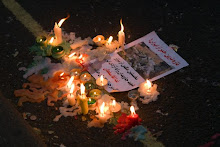
Atefeh comes to mind, but they didn’t expect anyone outside Iran, outside Neka even, to notice– we did and we’re still angry by the way. Come to think of it, this year, August 15th, (?) is the fifth anniversary of her murder…
This is the Wikipeida entry for Atefeh Rajabi Sahaaleh, it’s not bad as these things go. Here is a link to a blog about Atefeh with the youtube links to an American version of a documentary about her. There is also a BBC documentary, 'Execution of a Teenage Girl' available on youtube in five parts. Click here and type 'execution of a teenage girl' into 'search' to find the five pieces. Here’s one in French which is all in one, not in parts.
So, what of the exhibition?
Well, it hasn’t been cancelled, exactly, nor postponed, exactly. It has suffered from a bout of bureaucratic incompetence, conniving and malevolent malfunctioning that makes its pollution seem almost harmless. Having laboured day and night for five months on no pay, and produced a body of work that I like to think might hold its own in a gallery, having organised the transport and written the catalogue and done everything I should have done, I was refused a visa. So, just to clarify this: a government institution, namely the Museum of Contemporary Art, Esfahan, invites me to do the show and asks me to sign a contract and the very same government refuses to allow either me or the exhibition to enter the country.
Arcane dealings
The Foreign Ministry, part of central government, doles out the visas. The Museum is under the jurisdiction of provincial government of Esfahan. The process was as follows:
FM to Museum, ‘Send us a copy of the official letter confirming the exhibition.’
Museum to FM. ‘No – bugger off!’
FM to Museum, ‘Send us a copy of the email you sent her inviting her to exhibit.’
Museum to FM. ‘No – I said NO, now bugger off!’
Museum to me, (snarling): ‘The FM is trying to trick us into being your host but we are forbidden to be the host to any foreign artist - VERY VERY forbidden’
Bureaucratic language note: ‘host’ means someone who ‘takes responsibility for you all the time that you are in Iran.’ Meaning: if you do anything ‘wrong’ it becomes the fault of the ‘host’. Tough on an individual, but something you might think an institution could tolerate.
Technically, as far as I can tell and as far as anyone can tell, the museum is indeed the host, but they’re having none of it.
My interpretation: Museum has got very cold feet, possibly because ‘foreign artist,’ in this case, is ‘British artist' and, since A’jad (Ahmedinejad) is preparing to get in the bed with Ooooooooo ba mast, (Obama) a new ‘great satan’ must be found as a matter of urgency and the old ‘great satan’ ie Britain, will do just fine. Bum. That ‘s all I’ve got to say – in this post anyway. Actually I’ve said quite a bit more but it’s all off blog, hence my prolonged silence in this space. Oooooo baa maast, btw, is how Obama's name reads when it's written in Farsi. In effect it divides into three words, which just happen to mean 'he's with us' - ok, strictly it's ooo baa maa, 'he with us,' but what's a 'st' between friends? Back in November 2008, last time I was in Iran, this was considered a thigh slappingly funny joke at the news stands in Tehran. It was pretty funny the first few times.
So what now?
So, in principle, it could all just wait till the election’s over and the dust and pollution settles and ‘they,’ whoever ‘they’ are, get a bit less paranoid about foreigners, especially foreigners who have something called a BBC in their country that does unspeakable things like report on what goes on in Iran - occasionally. And what of the planned triste between Ooooob and A’jad? Will they or won't they? Will Oooooob get Mr. Mousavi instead? What about that poor women (Roxana Saberi) they’ve just stuffed in gaol for god knows how long as a bargaining chip?
October 2003, Tehran, lobby of Naderi hotel, Hassan to me: ‘This really is the most lawless bloody place I’ve every encountered.’ (‘Hassan’ teaches Middle Eastern politics and law at a well-known British University)
October 2004, London, Afsane’s kitchen, watching the rice, Felora to me: ‘Iran would be a great place, Claudia, but the problem is there’s no law.’
The tale of two ministries suggested that even Iranian officials are utterly confused by their own legal bureaucracy, but the Tale of Roxana says that in April 2009, they’ve just declared war on their own legal system. Many would say they did that decades ago, but it hasn’t been quite so fully-paid-up, so shamelessly public for some years has it? Or am I just deluded?
To more important matters
Atefeh comes to mind, but they didn’t expect anyone outside Iran, outside Neka even, to notice– we did and we’re still angry by the way. Come to think of it, this year, August 15th, (?) is the fifth anniversary of her murder…
This is the Wikipeida entry for Atefeh Rajabi Sahaaleh, it’s not bad as these things go. Here is a link to a blog about Atefeh with the youtube links to an American version of a documentary about her. There is also a BBC documentary, 'Execution of a Teenage Girl' available on youtube in five parts. Click here and type 'execution of a teenage girl' into 'search' to find the five pieces. Here’s one in French which is all in one, not in parts.
Friday, 6 March 2009
Klara Kristalova: Where The Owls Spend Their Days


It’s not often I walk into a ceramics show and feel a burst of joy followed by a sigh of satisfaction. In fact it’s extremely rare, but it happened last week. Things have happened since then which have left me feeling oppressed, bruised and sorely in need of something to lift the spirits. So I sneaked into Alison Jacques Gallery again today, to see if Klara Kristalova’s show was really as I’d remembered: fabulous – in all senses of the word. I sidled nervously past the first figure who stands alone elevated on a plinth in the entrance, surveying the audience with sunken face and long dark cloak, Dickensian and a bit threatening. In the main gallery a vast, dark cupboard looms out of a dimly lit space baring its contents, a collection of strange, yet instantly recognisable creatures. They’re magical and other-worldly, like toys but also like dreams or nightmares, visions or fantasies.
That sense of excitement and wonder was still there and it does offer relief to the spirit, in spite of the hint of anxiety lurking among the creatures in the cupboard.
Lets start with the top shelf of this over-sized toy cupboard. There are four joined heads, called ‘Family;’ a pansy; a woman with a very white face, black hair and the vestige of a lacy veil (?) across her eyes; and then another sunken face. All these are ceramic ‘figures’, white, black and colour, all saturated – it’s a bright white, a deep, inky black and a sweet, pansy-like purple, if it’s there at all. I might have added that with my own memory of the flowers. The imagination gets to work in a show like this. The way it’s been displayed invites it as does the work itself which seeps into the threads of your own memory. There’s a donkey on the next shelf down, sitting upright on the shelf, human-sitting pose, its (back) legs dangling over the edge of the shelf – front legs are ‘arms.’ Just looked at the picture, it is a human with a donkey head. Then there’s a girl with an owl head and shoulders– a Stoke on Trent type owl. There are lots more things. Go and see it. There’s ‘Dog-Friend’ on the bottom shelf and ‘Gluttony’ – a small girl devouring enormous grapes bigger than her, very very greeeeen grapes.
Room three has heads covered in moths on plinths. The moths are huge and congest the sight and nose and mouth of the head, you can sort of feel them in your own mouth – it’s all a bit unpleasant and furry. The moths’ wings are beautiful in a slightly clumsy ceramicy sort of way, thick wings, lines drawn a bit shakily – thick puddling glaze making bubbles and big crackle marks: gorgeous if worrying – the creatures not the crackles.
The show, entitled ‘Where the Owls Spend Their Days,’ is fables and fairy tales, not menacing exactly but provoking just enough anxiety to meet your own and feel like you’re among friends. I guess that’s where the sense of relief comes from. It also deliciously made, heavy-ish, visceral, painterly, almost sumptuous. I can’t think of anyone else working in this material who turns black and white into colour as successfully as she does. It is immensely impressive.
Kristalova joins a proud group of makers working with the figure / figurine and storytelling. I don’t want to list them here because I want to leave this post to her, but I will say that I think this strand in ceramic thinking and practice is probably the strongest at the moment. This show is certainly a joy to behold, and, curators, please go and see it – make it a priority, and see ceramic work displayed brilliantly. Thank you.
Tuesday, 3 February 2009


Monday, 26 January 2009
Philip Lane: A Tale of Treachery, Protection, Cucumbers and Marching Songs.
Cemal calls round last week. I haven’t seen him for ages. He’s been keeping a low profile in a charming northern city somewhere, railing against the lack of proper Turkish supermarkets, giving up smoking, complaining, nay mewling, about those other Kurds, those ‘Iranian’ ones, who turned out to be Iraqi, but also enjoying a good moan, breathing cleaner air, and getting very attached to his local, premier league, football team.
So we stroll out in the morning frost to investigate Philip Lane which, I realise, has completely changed since his departure last year. Now, he used to work at Aksu, little Aksu, the veg shop on the corner of Kitchener rd, that’s where I met him. Then the bigger shop by the bus stop, big Aksu, committed an act of unspeakable treachery. It started to stock vegetables too, not as well kept as those on the Kitchener rd corner, but veg nonetheless. The upshot was that little Aksu went 24 hours, then closed and was sold, unable to compete with its treacherous neighbour which now sold alcohol and veg. Little Aksu didn’t have room for alcohol and anyway Hussein’s wife was observant and didn’t really approve, so Hussein went and got drunk at the Turkish tea shop at the back of Botany Bay pub opposite and gambled away the shop’s meagre profit.
So, the ever stoical Cemal migrated over the road to work at Ocean Stores, another Turkish supermarket. We had only two so naturally a third was necessary. Mr. Ocean must have been a bit loaded so he bought up little Aksu as well and turned it into a butcher. That lasted less that a year, and was bought by Mr, Tea-shop-at-the-back-of-Botany-Bay-pub, affectionately known as ‘the Trafficker,’ on account of the alarmingly high turn over of Lithuanian women who worked at the bar in the tea-shop. So the Trafficker buys out the butcher’s shop and turns it into – yes that’s right – another of his lovely tea shops, because we’ve got only fifteen of them in Philip Lane / West Green road so, clearly, we need another.
Well then Mr. Ocean buys up the Turkish hostel at the back of Ocean Stores where my friends Cafar, Bilgen and their children used to live (in one room with the children in a bunk bed under the stairs in a corridor - happily they now live in a nice big flat at the back of Tescos opposite Seven Sisters), and where Cemal used to live, ‘bunking up’ with his mate, Rifat, and he, Mr. Ocean, extends Ocean Stores to include the butcher again. It’s now a pretty substantial supermarket. He even thoughtfully drops the price of soya milk from £1.29 to £1.19, having noticed at long last the Big Aksu has been selling theirs for £1.19 ever since they committed the cucumber coup.
Then what? Well, Botany Bay Pub was closed down and sold off around Christmas last year. Lately there’s been much activity and buying in of shop fittings and I ask the nice young woman at Ocean Stores what’s happening. Ocean Stores by now has doubled up as the local recruiting agency for the PKK. If you go there at the right time of day, there’s now a very chatty lad who plays, ‘communist marching song’s’ according to him. ‘I’m not supposed to,’ he confides and then starts trying to interest the hairy English anarchist man behind me, sporting ginger beard and desert fatigues, in joining up. He looks at me and boldly asserts, ‘there are almost as many women in the PKK as there are men, you know.’
I’m interested in more mundane matters though and, as the nice young woman counts my change, she informs me that Botany Bay is to be another supermarket – a really big one. ‘What sort of supermarket, which supermarket?’ I demand, dreading the onset of Tescos or similar. ‘Another Turkish family,’ she growls, and flares her nostrils for added emphasis.
Thing is, I cant see either Big Aksu or Mr Ocean going down without a fight and, given Ocean’s affiliations and Aksu’s protection racket which, according to Cemal, he started around the time of cucumber coup, I’m not sure if the sheer size of Botany Bay will be enough. The C Word’s prediction for 2009 is local skirmishes breaking out on the borders of N17 and N15, (BB is N15, Aksu and Ocean N17 – Philip Lane is the border,) resulting in possible all out war later in the year.
Maureen at the Laundrette on the corner of Philip Lane and Clonmell rd offers the best vantage point for anyone interested in observing from her splendid, full-size, picture windows. It was ideal for observing the fights at the pub and I’ve no doubt she’ll offer front row seats, tea so strong you could tar the road wit it, and a plentiful supply of her own unique Irish wisdom for all patrons in need. She also does a very fine line in second hand books. I wonder if there’s one about the battles of Broadwater Farm. Ah, now there’s another story. Thelma at the flower shop over the road can tell you all about that.
So we stroll out in the morning frost to investigate Philip Lane which, I realise, has completely changed since his departure last year. Now, he used to work at Aksu, little Aksu, the veg shop on the corner of Kitchener rd, that’s where I met him. Then the bigger shop by the bus stop, big Aksu, committed an act of unspeakable treachery. It started to stock vegetables too, not as well kept as those on the Kitchener rd corner, but veg nonetheless. The upshot was that little Aksu went 24 hours, then closed and was sold, unable to compete with its treacherous neighbour which now sold alcohol and veg. Little Aksu didn’t have room for alcohol and anyway Hussein’s wife was observant and didn’t really approve, so Hussein went and got drunk at the Turkish tea shop at the back of Botany Bay pub opposite and gambled away the shop’s meagre profit.
So, the ever stoical Cemal migrated over the road to work at Ocean Stores, another Turkish supermarket. We had only two so naturally a third was necessary. Mr. Ocean must have been a bit loaded so he bought up little Aksu as well and turned it into a butcher. That lasted less that a year, and was bought by Mr, Tea-shop-at-the-back-of-Botany-Bay-pub, affectionately known as ‘the Trafficker,’ on account of the alarmingly high turn over of Lithuanian women who worked at the bar in the tea-shop. So the Trafficker buys out the butcher’s shop and turns it into – yes that’s right – another of his lovely tea shops, because we’ve got only fifteen of them in Philip Lane / West Green road so, clearly, we need another.
Well then Mr. Ocean buys up the Turkish hostel at the back of Ocean Stores where my friends Cafar, Bilgen and their children used to live (in one room with the children in a bunk bed under the stairs in a corridor - happily they now live in a nice big flat at the back of Tescos opposite Seven Sisters), and where Cemal used to live, ‘bunking up’ with his mate, Rifat, and he, Mr. Ocean, extends Ocean Stores to include the butcher again. It’s now a pretty substantial supermarket. He even thoughtfully drops the price of soya milk from £1.29 to £1.19, having noticed at long last the Big Aksu has been selling theirs for £1.19 ever since they committed the cucumber coup.
Then what? Well, Botany Bay Pub was closed down and sold off around Christmas last year. Lately there’s been much activity and buying in of shop fittings and I ask the nice young woman at Ocean Stores what’s happening. Ocean Stores by now has doubled up as the local recruiting agency for the PKK. If you go there at the right time of day, there’s now a very chatty lad who plays, ‘communist marching song’s’ according to him. ‘I’m not supposed to,’ he confides and then starts trying to interest the hairy English anarchist man behind me, sporting ginger beard and desert fatigues, in joining up. He looks at me and boldly asserts, ‘there are almost as many women in the PKK as there are men, you know.’
I’m interested in more mundane matters though and, as the nice young woman counts my change, she informs me that Botany Bay is to be another supermarket – a really big one. ‘What sort of supermarket, which supermarket?’ I demand, dreading the onset of Tescos or similar. ‘Another Turkish family,’ she growls, and flares her nostrils for added emphasis.
Thing is, I cant see either Big Aksu or Mr Ocean going down without a fight and, given Ocean’s affiliations and Aksu’s protection racket which, according to Cemal, he started around the time of cucumber coup, I’m not sure if the sheer size of Botany Bay will be enough. The C Word’s prediction for 2009 is local skirmishes breaking out on the borders of N17 and N15, (BB is N15, Aksu and Ocean N17 – Philip Lane is the border,) resulting in possible all out war later in the year.
Maureen at the Laundrette on the corner of Philip Lane and Clonmell rd offers the best vantage point for anyone interested in observing from her splendid, full-size, picture windows. It was ideal for observing the fights at the pub and I’ve no doubt she’ll offer front row seats, tea so strong you could tar the road wit it, and a plentiful supply of her own unique Irish wisdom for all patrons in need. She also does a very fine line in second hand books. I wonder if there’s one about the battles of Broadwater Farm. Ah, now there’s another story. Thelma at the flower shop over the road can tell you all about that.
Subscribe to:
Posts (Atom)