Showing posts with label Bradford. Show all posts

Monday, 28 October 2019

March Against the Sex Trade, Filia Conference 2019, Bradford.


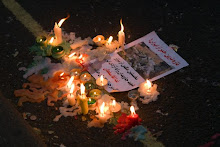
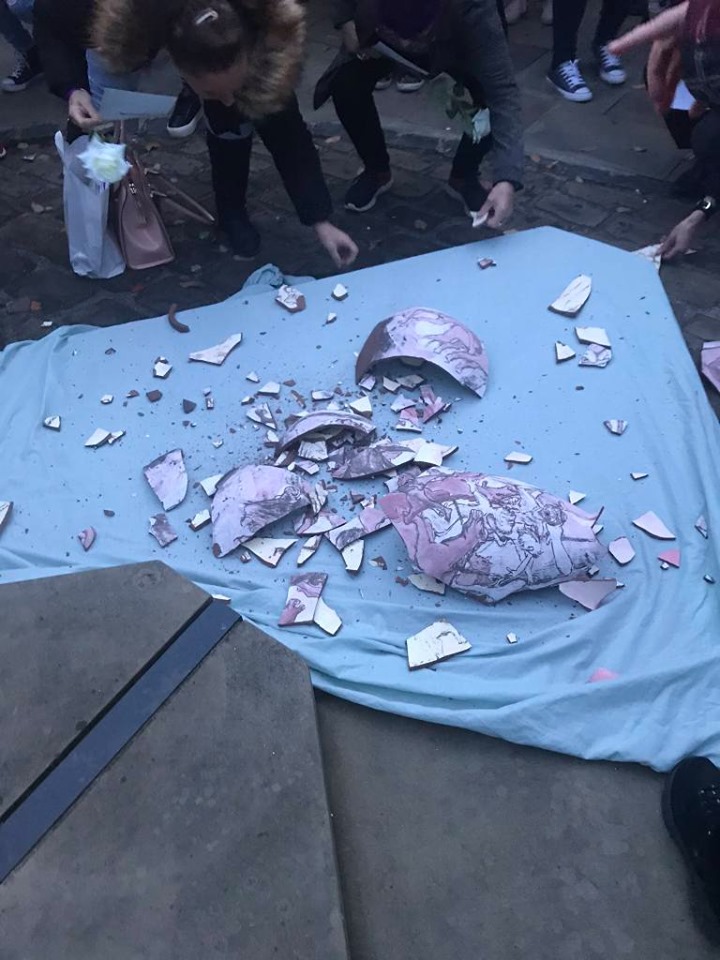
The March Against the Sex Trade took place on the Saturday evening, October 19th, at the end of day one of Filia conference. We assembled at twilight and processed to Centenary Square, the main square in Bradford. There we gathered in a circle and, after an introduction by Fiona Broadfoot, read out the names of all the women who had been murdered while exploited in prostitution. Shocking how long it took. As daylight was faded, and the sky went deep blue, we held up white roses and cards, each with the name of one murdered woman, and called out the names again, all together this time, like a Greek Chorus. Once all the names had been sounded at least three times, we had a minute’s silence to reflect on the harms of prostitution and sex trade, and to remember the lives and deaths of the women whose names were called. ‘The Invisible Man,’ the pot set up in the centre of the circle, ‘broke the silence,’ as it smashed on to the paved stone ground, releasing the images of women painted inside.

The memorial concluded with a song and a dance by an Argentinian woman, one of the conference speakers, whose daughter had been abducted, prostituted, and murdered in Buenos Aires.

Perhaps the most significant part though was this: I was about to collect and wrap up the shards when a young man who was passing by with his girlfriend, asked me if I knew Rebecca Hall, one of the women whose names were called out during the memorial. ‘I knew her,’ he said, ‘She was one of my best friends at school. This means so much to me.’ He then went and spoke to the woman holding the card with Rebecca’s name on it. You can read about Rebecca here.

The shards are now on their way back to the studio where they will be glazed and the pot reassembled but with pieces left out so you can see the images of the women painted inside. If all goes according to plan, the internal images – the women - will dominate. You will see them rather than the men depicted on the outside of the pot. The shattering and mending of a pot is a simple metaphor, reflected in the words, ‘I was shattered. Now I’m piecing myself slowly back together.’

Among my proudest moments, as a feminist and a potter, are when my pots are part of feminist activism, especially activism against the sex trade and the call for abolition. The March Against the Sex Trade was an action done as part of a feminist conference but in a public space. Reaching out to survivors, to family and friends of survivors, and to passers by  - the public in the most general sense, is surely the most important of any campaign. It was a huge honour to be part of it.

The names of the women murdered in prostitution in Bradford
May 21 2010, Suzanne Blamires, 36
April 26 2010 Shelley Armitage, 31
June 22 2009, Susan Rushworth, 43
April 26 2001: Rebecca Hall, 19
May 2000 Gemma Simpson, 23
October 1996: Caroline Creevy, 25
June 8 1995: Maureen Stepan, 18
1992 Yvonne Fitt, 32
1984: Deborah Kershaw,22
January 21 1978: Yvonne Pearson, 21
Wiki page – women UK-wide  - This is UK and Ireland - from 2010-today. 

Fiona Broadfoot is one of the women bringing the judicial review aiming to get convictions removed from the record of exited women and remove the need for disclosure which represents a major barrier for prostituted women who are trying to exit.
Photos from top: 1- Studio Twelve, 2 and 3 - Deb Ball, 3,4 and 5 - Claudia Clare

Thursday, 30 October 2008

Connecting Cultures: Relaunching the collections at Cartwright Hall, Bradford

Cartwright Hall is one of those stately, Victorian monuments to wool, civic pride, ambition, wealth and paternalistic duty which graces many a small, middling-sized and large town in Northern England. It was purpose built in 1904 to house the art collection of one Mr. Lister, local wool magnate, and continues to function as a magnificent museum and art gallery. It was recently refurbished and the collections were re-curated and displayed thematically, which has allowed the historic collection to meet and mingle with the contemporary collection in a way that brings new meaning to both and probably new audiences too.

About the Collection
Cartwright Hall’s contemporary collection has never been ‘medium-specific,’ the collection was not either acquired or organised according the material from which the work was made, such as metal work, ceramics, textiles or photography, but rather according to narrative and meaning. At one time there was a ‘transcultural collection’ which focused of arts from the Indian sub-continent and on contemporary South Asian and diaspora art. It then expanded and the collecting policy became an early exemplar of ‘diversity’ in art acquisitions. The result is probably one of the most interesting public collections in Britain. Ok, I’m biased, I have work in it, but mine’s a very early work, don’t get too excited. It’s the mix and now the arrangement of the works that is so successful. Some wonderful, classic Orientalist works sit alongside contemporary work exploring migration narratives where they can quietly or noisily comment on each other without much need for interference from clunky curatorial text telling the audience what to think.

Connect, the current exhibition
The relaunch of the collections and of the current exhibition, ‘Connect,’ was followed by a short symposium on contemporary museum display in which seven of us, with work in the collection, opined as eloquently as we could on the matter of public collections. ‘Opportunity or risk?’ was the question posed and which we were asked to address in our three-minute presentations. All of us emphasised the opportunity, I think only two of us discussed the risks. I’d welcome the chance to be in more collections of this sort, the risks of having your work sanitised and intellectually vandalised by the sort of craft curators who really want to discuss only your provenance, authenticity, medals and firing temperatures are fewer I think. That said, I wouldn’t mind the chance of risking that either, but since most ceramic collections are, alas, absolutely material-specific and concentrated on the modernist, truth-to-materials drone, I don’t think I’ve got too much to worry about - unfortunately.

Good Practice
Thinking about good practice, Cartwright must also be held up as an example with their young ambassadors project. This is an outrageously audacious attempt at commandeering disaffected, callow youth, locating their art-lover within and then, as if that wasn’t enough, asking them to set about developing their teenage and early 20-something pals into sophisticated, eloquent and articulate gallery-goers too. The astonishing thing is that it’s working brilliantly. These kids are going to be holding forth about neo-modernist, quasi-de-Waalian, late 20th century handle-less pale-ware, before you can say ‘cylinder’. Can I cope?